
By Sandra Ponzanesi
Professor of Media, Gender and Postcolonial Studies, Utrecht University
Achille Mbembe came to Utrecht to ask a hard question: how do we make solidarity futureproof? From abolition and anti-apartheid to Gaza and planetary justice, he called for sharing, caring, and repairing—with Africa as a laboratory of the future.
Watch the lecture here: https://vimeo.com/1138925965?share=copy&fl=sv&fe=ci
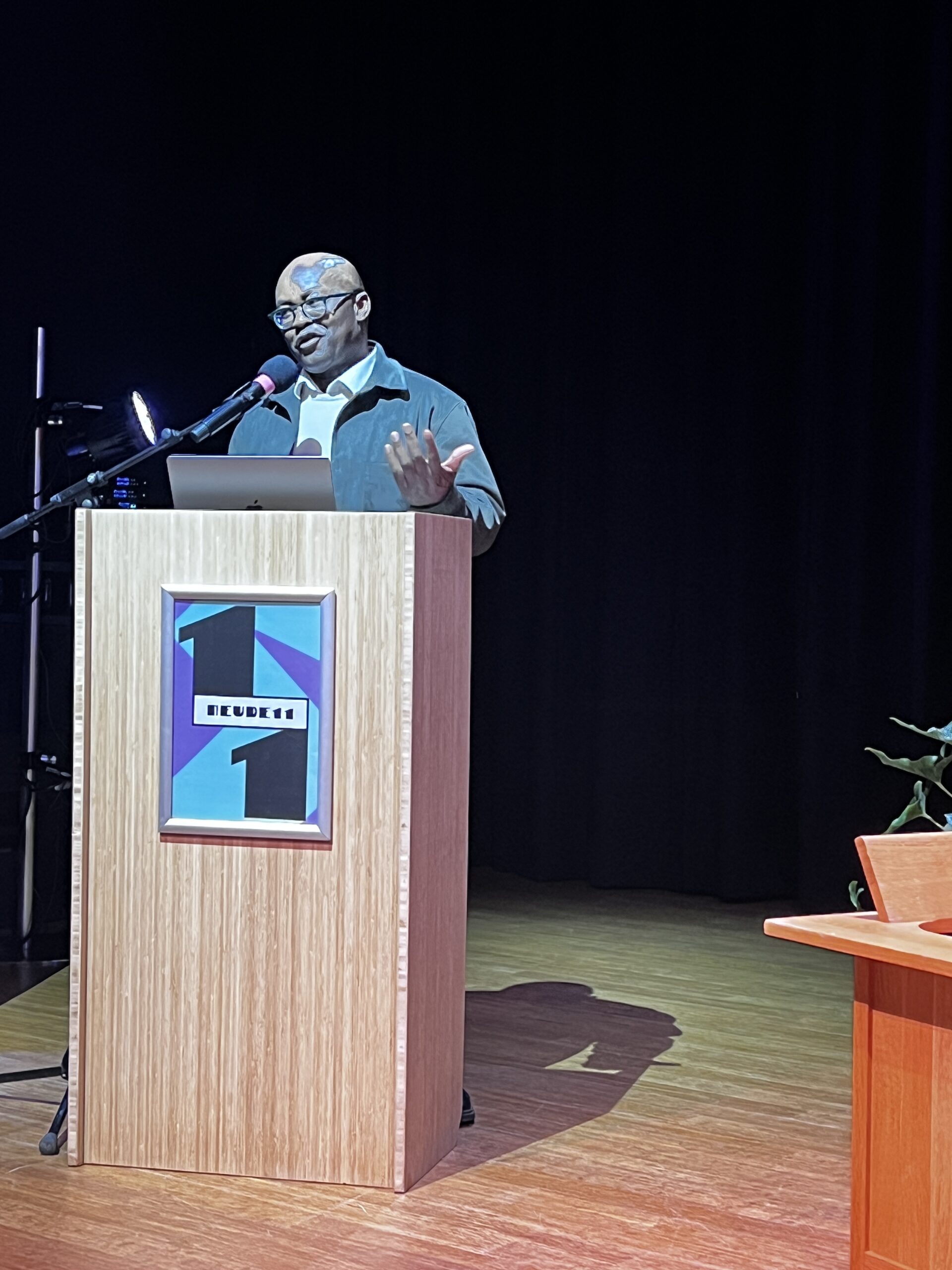 On November 25, 2025 Achille Mbembe delivered a packed public lecture on “Futureproof Solidarity” at the Utrecht Public Library, Neude. The event marked his visit to the Netherlands as laureate of the International Spinozalens, a prestigious biennial award honoring thinkers who shape urgent public debate through critical reflection. Mbembe received the 2025 Spinozalens Prize in The Hague on November 24, Spinoza’s birthday.
Introducing Mbembe, Sandra Ponzanesi (chair and moderator) highlighted his far-reaching impact as one of today’s most incisive public intellectuals. Born in Cameroon in 1957, Mbembe is Research Professor at the Wits Institute for Social and Economic Research (WISER), University of the Witwatersrand, Johannesburg, and Director of the Innovation Foundation for Democracy. Educated in Cameroon and France, he earned a PhD in History at Université Paris 1 Panthéon-Sorbonne and a Diplôme d’études approfondies at Sciences Po Paris. He has held positions at Columbia University, the Brookings Institution, the University of Pennsylvania, UC Berkeley, Yale, Duke, and CODESRIA in Dakar. In 2024 he received the Holberg Prize, often described as the Nobel Prize for the Humanities.
Why Mbembe’s work matters
Across major works including On the Postcolony, Critique of Black Reason, Necropolitics, Brutalism, Out of the Dark Night, and The Earthly Community, Mbembe examines how the afterlives of empire shape mobility, citizenship, and planetary cohabitation. His concept of necropolitics—how power decides who may live and who must die—has become foundational for understanding racialized regimes of control and their entanglement with environmental devastation. His writing also interrogates how extractive forces harden borders, infrastructures, and bodies. Yet his work is not only diagnostic; it is animated by an ethical and imaginative commitment to renewal.
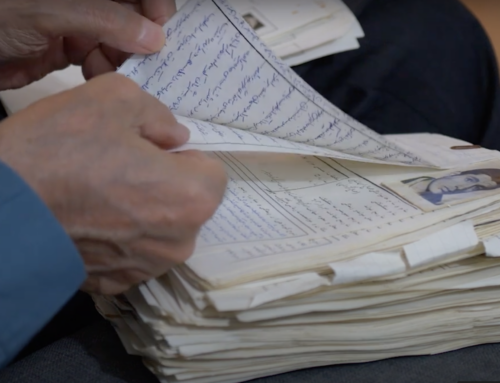
The archive, for Mbembe, is a key site of struggle and possibility. Archives are not inert repositories. They carry the scars of colonial extraction while containing the unrealized potential of alternative genealogies. Reading against and beyond their original intent, he suggests, can help animate new solidarities in a world haunted by imperial debris.
Solidarity under duress
In Utrecht, Mbembe connected today’s emergencies across geographies—Sudan, the Democratic Republic of the Congo, the Mediterranean, Ukraine, and Gaza—to ask how solidarity might be made futureproof: durable, sustainable, and capacious enough to meet planetary crises.
He traced historical lineages of solidarity, from the abolitionist movement and Harriet Tubman’s Underground Railroad to contemporary struggles against the afterlives of the plantation system in U.S. mass incarceration, a critique powerfully articulated by Angela Davis. He also reflected on the anti-apartheid movement in South Africa as a model of transnational solidarity.
Turning to Gaza, he described a form of necropolitics that, in his view, differs from other occupations by three features:
- siege by land, air, and sea;
- devastation that is forewarned and cumulative rather than sudden;
- a population unable to flee.
He argued that the world is witnessing this process, and that normalization and indifference erode empathy and our ability to imagine how to share the Earth. Building transnational solidarity, he suggested, requires acknowledging injustices from which none of us are entirely separate.
This is, for Mbembe, the ground zero of solidarity today: reclaiming solidarity under duress. The task is to learn how to share, care, and repair—holding together remembrance of past violence with attention to present atrocity. Real solidarity means a willingness to look, to bear witness, and to defend lives made to not matter. Even as he calls us to journey into the abyss of the present, Mbembe insists on resilience and the capacity to reimagine the future—drawing especially on the African archive as a resource for a democracy yet to come.
Africa as a laboratory of the future
Mbembe locates the future of solidarity in Africa, not as a romantic return but as a site of experimentation where interdependence, creative practice, and digital cultures generate new political imaginaries. His notion of planetary entanglement calls for solidarities that transcend borders and foreground shared vulnerability, environmental justice, and the right to breathe.
Responses from Utrecht scholars
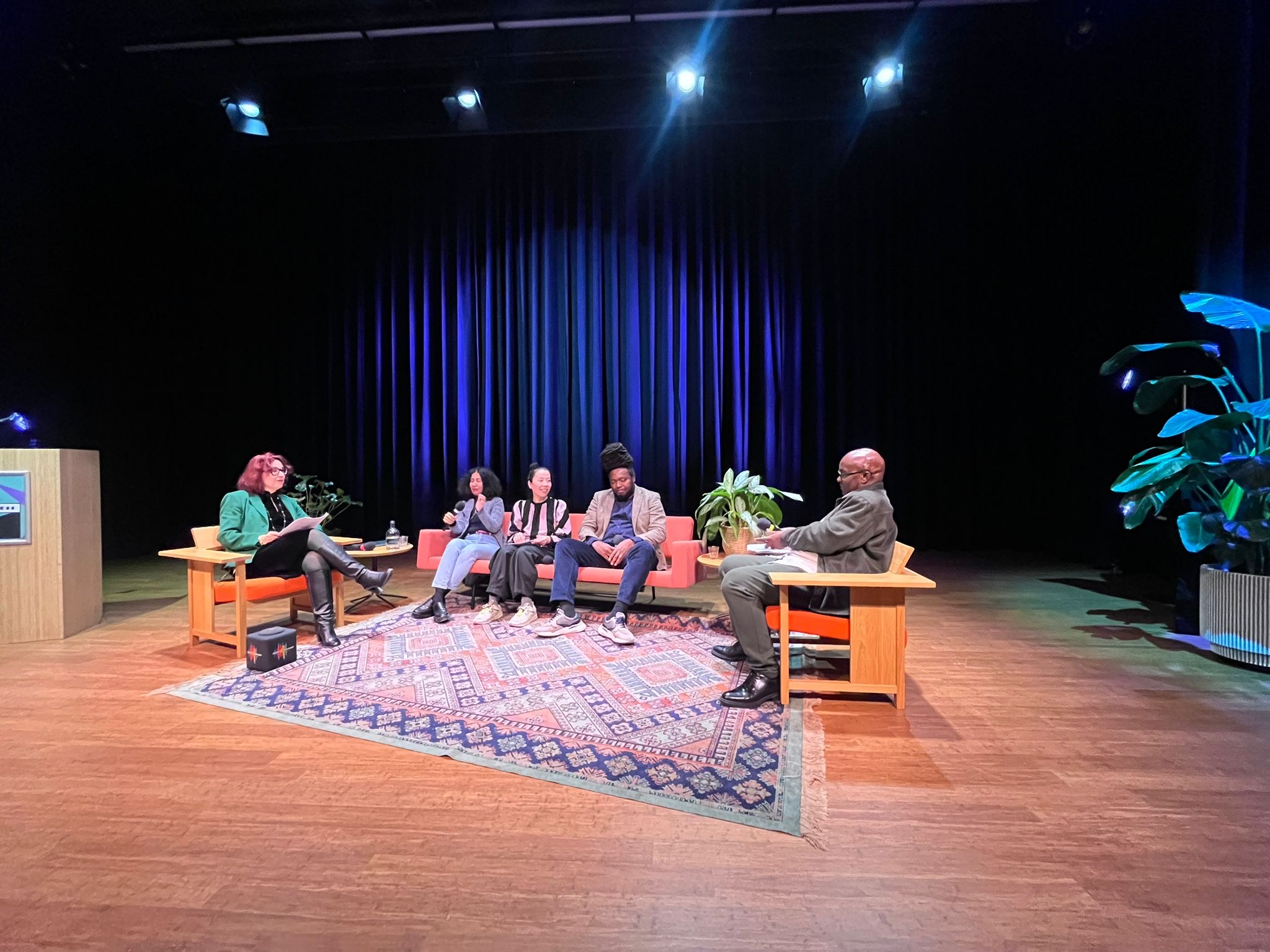 Three Utrecht University scholars extended Mbembe’s arguments from their own disciplines:
- Kei Otsuki (Professor of International Development Studies) asked how redistribution and sustainability can be meaningfully shared at a planetary scale—and who the “we” is in such projects.
- Bruce Mutsvairo (Professor and Chair of Media, Politics and the Global South) emphasized everyday technologies in the Global South as tools of empowerment, complicating knee-jerk critiques of technosolut ionism.
- Jamila Mascat (Assistant Professor of Gender and Postcolonial Studies) reflected on Afro-radicalism and how to think rebellion beyond Afro-pessimism, proposing practices of “in-commoning” emerging from the African continent.
Together, they navigated the richness of Mbembe’s oeuvre—history, philosophy, political theory, aesthetics, and digital futures—opening multiple entry points and, in effect, assembling their own living archive of Mbembe’s ideas.
Why it matters now
Futureproof solidarity is not a slogan. It is a practice that braids memory, responsibility, and imagination. Mbembe’s lecture urged an ethics of sharing, caring, and repairing across planetary entanglements, with Africa as both teacher and horizon. The challenge is to resist indifference, attend to life made precarious, and build solidarities that can endure—and transform—the world we share.
Note: This recap reflects the lecture and responses as heard by the author. Any errors or omissions are our own.
The event was organized by:
International Spinoza Prize Foundation
Institutions for Open Society (Gender, Diversity and Global Justice Platform)
Network for Environmental Humanities.
Pathway to Sustainability (Critical Pathways)